-
-
-
Plot No -18, Tirumala Hans Industrial Park, Indore, India
BDV Testing of Transformer Oil: Complete Guide as per IS 6792:2023 & IEC 60156:2018
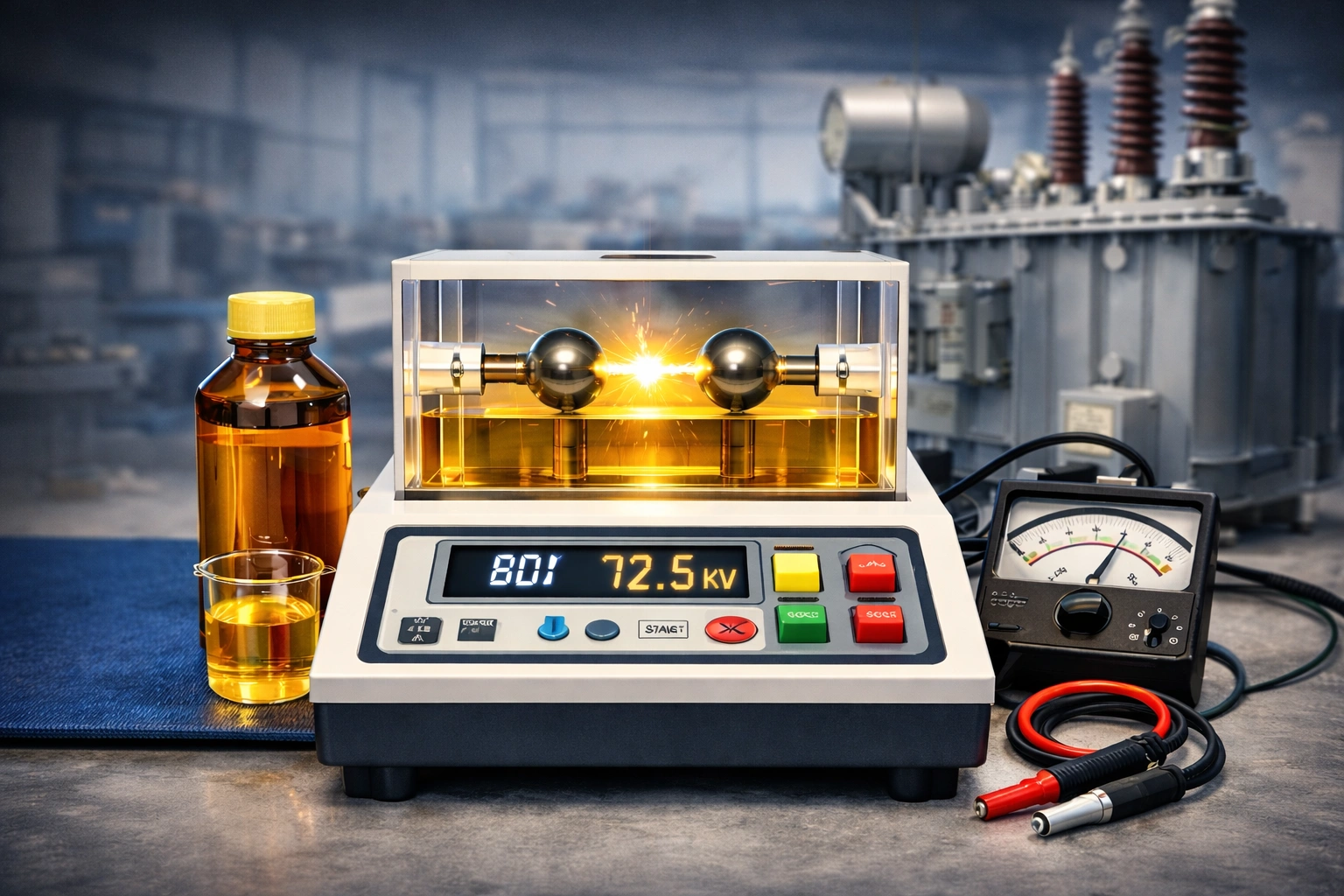
Did you know that over 70% of transformer failures start with contaminated oil? And the first warning sign? A low BDV value.
Breakdown Voltage (BDV) Testing is a laboratory method used to determine the dielectric strength of mineral insulating oil used in transformers and oil-filled electrical equipment. The test measures the voltage at which the oil electrically breaks down under standard conditions.
At Oorja Technical Services, we provide BDV test of transformer oil through our NABL-accredited transformer oil testing laboratory. Conducted as per IS 6792:2023 / IEC 60156:2018, and guided by maintenance practices in IS 1866:2017 / IEC 60422:2013, our laboratory BDV testing helps industries assess insulation performance, detect contamination, and prevent transformer failures.
It is one of the most important preventive maintenance tests in electrical asset management — and we do it right.
WHY BDV TESTING MATTERS
Transformer oil plays two critical roles — it insulates the internal components and cools the transformer during operation. But over time, this oil degrades.
What reduces BDV?
- Moisture ingress
- Carbon particles from arcing
- Sludge formation
- Oxidation byproducts
- Dust and dirt
A low BDV value increases the risk of internal arcing, flashover, and complete insulation failure.
Benefits of Regular BDV Testing:
- Early detection of contamination
- Improved transformer reliability
- Reduced risk of electrical breakdown
- Compliance with industry safety standards
- Extended equipment service life
- Cost-effective preventive maintenance
Laboratory testing provides accurate, repeatable, and standard-compliant results — something field tests cannot guarantee.
BDV TEST METHOD: IS 6792:2023 / IEC 60156:2018
Our transformer oil testing laboratory follows strict procedures to ensure accuracy:
|
Step |
Procedure |
|
1 |
Oil sample collected in a clean, moisture-free bottle |
|
2 |
Test cell cleaned and electrode gap set to 2.5 mm |
|
3 |
Oil poured into the BDV chamber without bubbles |
|
4 |
AC voltage applied at a uniform rate (2 kV/sec) |
|
5 |
Breakdown voltage recorded at flashover |
|
6 |
Six readings taken, and the average calculated |
|
7 |
The final result indicates dielectric strength |
We use an automatic bdv tester for precise, repeatable results — eliminating human error.
BDV ACCEPTANCE CRITERIA
As per transformer oil bdv test standards, here's what the values mean:
|
BDV Value (kV) |
Condition |
Action Required |
|
> 60 kV |
Excellent |
Normal monitoring |
|
50 - 60 kV |
Good |
Routine check |
|
40 - 50 kV |
Fair |
Observe closely |
|
30 - 40 kV |
Poor |
Filtration needed |
|
< 30 kV |
Critical |
Immediate replacement |
Note: Acceptance values may vary based on equipment voltage class and internal maintenance policy. Always refer to equipment manufacturer guidelines.
For new oil as per IS 335, the minimum BDV should be 50 kV. For in-service transformers, values above 40 kV are generally acceptable.
WHAT YOU CAN DO WITH BDV TESTING
✔ Decide whether oil needs filtration or replacement
✔ Approve new oil before transformer commissioning
✔ Monitor oil condition periodically (quarterly/half-yearly)
✔ Compare oil quality trends over time
✔ Support preventive maintenance planning
✔ Ensure compliance with IS 1866:2017 guidelines
✔ Document oil health for audit purposes
WHAT YOU SHOULD NOT DO
✘ Do not rely only on BDV for transformer health assessment
✘ Do not ignore moisture testing — it goes hand-in-hand with BDV
✘ Do not test visibly contaminated samples without pre-treatment
✘ Do not skip electrode cleaning between tests
✘ Do not compare results without considering the voltage class
✘ Do not use expired or uncalibrated BDV testers
Following proper testing procedures ensures reliable, repeatable results.
BEYOND BDV: COMPLETE TRANSFORMER OIL ANALYSIS
While BDV testing is essential, it tells only part of the story. For a complete transformer health assessment, combine it with:
|
Test |
What It Detects |
|
Dissolved Gas Analysis (DGA) |
Internal faults (arcing, overheating, discharge) |
|
Moisture Content |
Water percentage in oil |
|
Acidity Test |
Oil oxidation and sludge potential |
|
Furan Analysis |
Paper insulation degradation |
|
Interfacial Tension (IFT) |
Contamination and oxidation |
|
Resistivity & Tan Delta |
Overall insulation quality |
At Oorja Technical Services, we offer complete transformer oil analysis through our NABL-accredited transformer oil testing laboratory — so you get the full picture.
INDUSTRIES WE SERVE IN INDIA
BDV testing services in India are required across:
|
Sector |
Applications |
|
Power Generation |
Thermal, hydro, nuclear, solar, wind plants |
|
Transmission & Distribution |
33kV to 400kV substations |
|
Heavy Industries |
Steel, cement, fertiliser, oil & gas |
|
Infrastructure |
Railways, metro systems, airports |
|
Commercial |
Data centres, hospitals, IT parks |
|
Manufacturing |
Automotive, textile, and chemical plants |
Wherever there's a transformer, regular transformer oil testing is part of mandatory maintenance programs