-
-
-
Plot No -18, Tirumala Hans Industrial Park, Indore, India
Beyond Calibration: How Integrated Electrical Testing Prevents Downtime, Revenue Leakage, and Grid Penalties

Calibration answers a simple question: Is this instrument telling the truth? But in the field, that question is rarely the whole story. A perfectly calibrated relay test set means little if the relay it is testing has drifted out of coordination. A certified energy meter reference standard cannot recover revenue lost to a mis-wired CT. And a power quality analyzer accurate to fractions of a percent will not, by itself, save a plant from harmonic penalty exposure.
This is the gap that Oorja Technical Services Pvt. Ltd. (OTSPL) was built to close. With 25 years of technical expertise, NABL accreditation under ISO/IEC 17025:2017 (Calibration Certificate No. CC-3963; Testing Certificate No. TC-11691), and a presence in every state of India backed by 500+ skilled professionals, Oorja operates not just as a calibration laboratory but as an integrated electrical testing, calibration, and maintenance partner.
The Integrated Model: Testing, Calibration, and Remediation Under One Roof
What distinguishes Oorja's approach is a closed-loop delivery model. Testing, calibration, and remedial maintenance are delivered under one roof—so clients do not have to coordinate between multiple vendors, and test findings lead directly to corrective action. The workflow moves from diagnosis to verification to intervention, with every step traceable and audit-ready.
1. Instrument Transformer Testing: Where Revenue and Protection Both Live
Instrument transformers are the "eyes and ears" of protection and metering systems. Oorja's NABL-accredited CT and PT services cover ratio testing, ratio and phase error calibration, burden measurement, saturation characterization, and accuracy verification.
The capability ranges are substantial: CTs from 1 A to 3200 A primary and PTs from 220 V up to 33 kV. This dual focus matters because a CT that is accurate for metering but saturates poorly under fault conditions can simultaneously under-bill the utility and fail to trip a breaker. Testing both the metering and protection characteristics closes that exposure.
2. Energy Metering: NABL-Accredited Verification for Revenue Integrity
Oorja provides NABL-accredited calibration and testing for energy meters and smart meters, covering both single-phase and three-phase devices, along with reference standard energy meters. The stated purpose is direct: precise metering reduces revenue leakage and supports fair billing for utility-grade systems. Because the laboratory is accredited under ISO/IEC 17025, the resulting certificates carry national traceability and are accepted by regulatory bodies and auditors.
3. Relay and Protection Testing: From Component to System
Beyond calibrating relay test sets, Oorja performs relay testing services for protective relays including overcurrent, earth fault, under/over-voltage, reverse power, auxiliary, numerical, differential, and distance relays, along with calibration and setting verification. This is a critical distinction for asset managers: the deliverable is not merely a calibrated instrument, but verified protection coordination.
4. High Voltage and Insulation Diagnostics
Oorja's documented high-voltage testing capability extends to 100 kV DC and 5 kV AC, used to verify insulation and component robustness. The published range for insulation-related work includes Hi-Pot cable testing and insulation resistance measurement from 500 V to 5000 V DC across cables and CTs/PTs. Because insulation failure is among the leading causes of electrical fires and catastrophic equipment failure, this testing is preventive rather than merely documentary.
5. Power Quality: A 7-Day Methodology, Not a Spot Check
For power-generating station customers and industrial facilities facing harmonic penalty exposure, Oorja conducts a 7-day continuous Power Quality Analysis as per IEEE 519, rather than a brief spot measurement. The extended window captures shift changes, weekend shutdowns, and varying production cycles—conditions under which intermittent power quality problems otherwise go undetected.
The measured parameters include Total Voltage Distortion (THD), individual voltage harmonics, short- and long-term flicker (Pst/Plt), Total Demand Distortion (TDD), and individual current harmonics, captured at both 3-second and 10-minute intervals. TDD is particularly important: unlike THD, it measures current distortion relative to maximum demand load, making it a critical metric for IEEE 519 compliance. Oorja also aligns its power quality scope with IEC 61000 standards for harmonic and disturbance detection.
6. The Broader Diagnostic Envelope
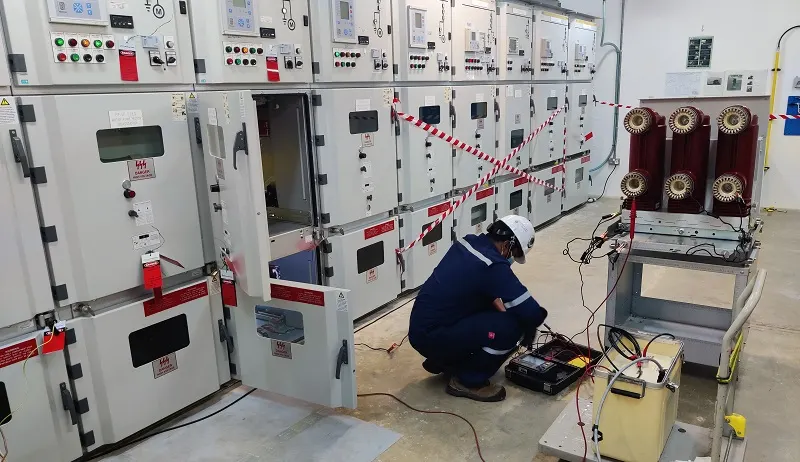
The testing portfolio extends further into asset health: transformer oil testing including Dissolved Gas Analysis (DGA), BDV, furan analysis, acidity, flash point, IFT, density, viscosity, and moisture testing, along with oil filtration services; thermographic inspection of electrical panels to identify loose connections and overloaded circuits; earth pit resistance testing for grounding effectiveness; and switchgear testing and maintenance including air and vacuum circuit breakers.
Why the Integrated Model Matters
Electrical assets age silently—insulation weakens, contacts loosen, relays drift, and transformer oil degrades, often with no visible warning. Testing converts that guesswork into data-driven decision-making, preventing failures, improving protection coordination, and reducing energy losses. Oorja's stated approach is to deliver unbiased technical data so asset managers can act before failure, not after.
For a technical audience, the value proposition is straightforward: one accredited partner, one traceable data chain, and one point of accountability from diagnosis through correction. In a sector where a single undetected fault in a transformer, relay, panel, or high-voltage asset can trigger costly downtime, safety incidents, and regulatory penalties, that integration is not a convenience—it is a risk-management strategy.